
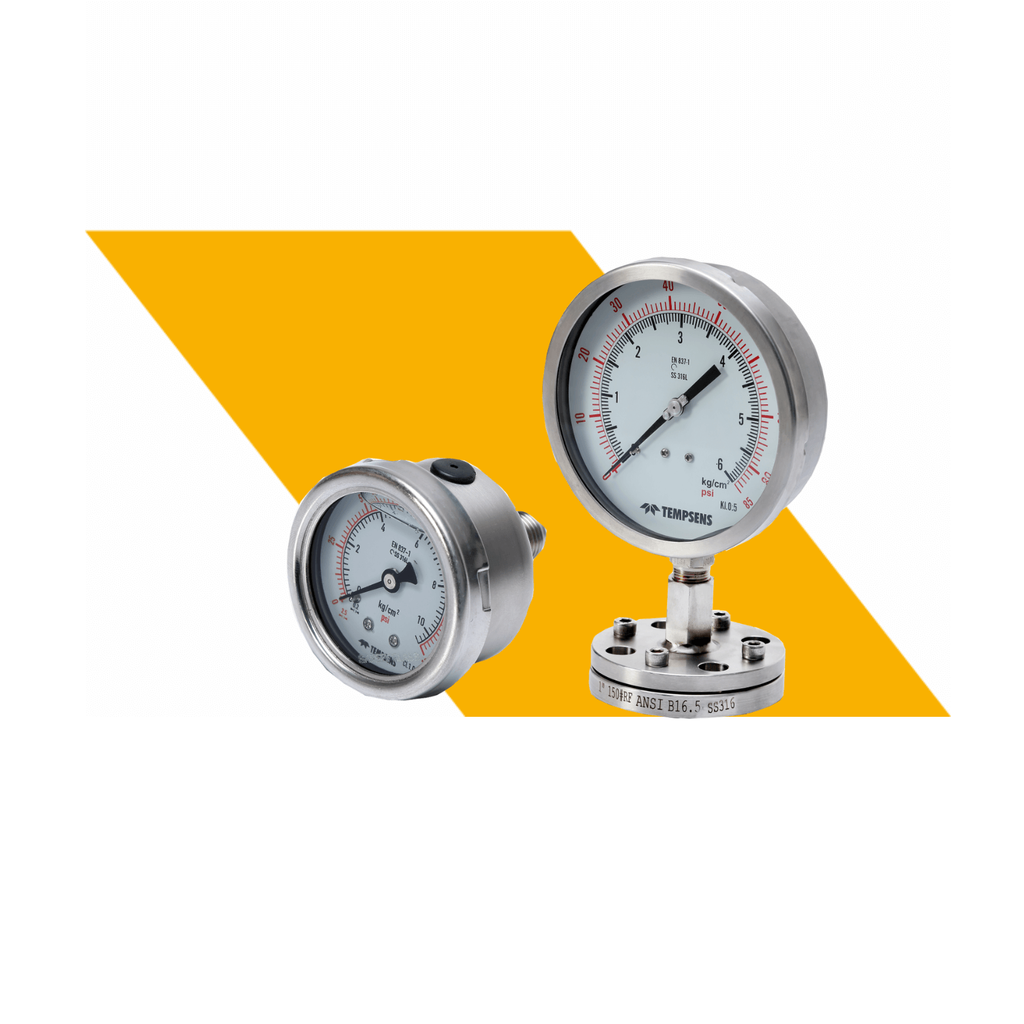
A pressure gauge can be doing its job one minute and giving misleading readings the next. On a busy plant floor, pressure rarely stays perfectly steady. Pumps start and stop, compressors cycle, valves close, and machinery sends vibration through connected pipework. These conditions are part of everyday operations, but they can be hard on the instruments expected to monitor them.
The trouble is that gauge damage isn’t always obvious. A pointer may still move and display a reading, even when the mechanism has started to wear or its accuracy has shifted. For operators, that creates a bigger concern than a faulty dial: they may be making decisions based on information they can no longer trust.
Protecting industrial pressure gauges starts with understanding what is happening in the process, not simply choosing a gauge with a suitable pressure range.
Key Highlights
- Brief pressure spikes can damage a gauge, even when normal operating pressure is within its range.
- Pulsation and mechanical vibration have different causes and need different forms of protection.
- Snubbers, liquid-filled cases and overpressure protectors each serve a specific purpose.
- Installation, process temperature and media compatibility all affect gauge life.
- Repeated gauge failures should prompt a review of operating conditions, not just another replacement.
Overpressure: The Damage Can Happen in an Instant
Imagine a pump operating normally, with its pressure gauge showing a steady reading. Then a valve closes suddenly. Pressure rises sharply, but the spike lasts only a fraction of a second.
The operator may not even notice it. The gauge, however, has taken the hit.
In a mechanical gauge, excessive pressure can permanently deform the sensing element, affect the pointer’s zero position or damage internal components. Repeated spikes can make the problem worse over time.
This is why selecting a gauge based only on average operating pressure can be misleading. Engineers also need to consider start-ups, shutdowns, valve movements, and other events that may push pressure beyond its normal range.
An overpressure protector can help where pressure excursions are expected. But choosing a much higher measurement range just to avoid damage isn’t always the answer either. The gauge still needs to show normal operating changes clearly.
Pulsation and Vibration: Similar Symptoms, Different Problems
A pointer that keeps trembling is often the first warning sign. But before fitting a new gauge, it helps to understand what’s causing the movement.
Pulsation is the repeated rise and fall of pressure, commonly seen in reciprocating pumps and compressors. Mechanical vibration, on the other hand, comes from moving machinery and travels through pipework and mounting points.
Both can affect gauge accuracy, but they need different solutions. A snubber or pulsation dampener helps reduce pressure fluctuations before they reach the gauge. A liquid-filled gauge can make the pointer easier to read and help damp movement inside the case. If the vibration is coming from nearby machinery, remote mounting or a more stable mounting point may be more effective.
Simply fitting a liquid-filled gauge won’t solve every pulsation problem. Equally, a snubber won’t stop vibration travelling through a pipe support.
Choosing Protection That Suits the Process
There is no single accessory that works for every application. The right choice depends on the pressure pattern, process medium, temperature, and installation.
| Operating condition | Protection to consider |
| Sudden pressure spikes | Overpressure protector |
| Repeated pressure pulsation | Snubber or pulsation dampener |
| Machinery vibration | Liquid-filled gauge or remote mounting |
| High process temperature | Siphon or suitable cooling arrangement |
| Corrosive or viscous media | Compatible diaphragm seal |
There are trade-offs, too. A snubber slows the pressure changes reaching the gauge. That is useful for reducing pointer movement, but too much restriction can make the reading respond slowly. In some processes, that delay could hide a change operators need to see.
The accessory must also suit the process medium. A small restriction can become blocked if the fluid contains solids or deposits. A material that works well in one service may not be suitable for another.
The point is to protect the instrument without losing sight of what it is there to measure.
Installation Can Make or Break Gauge Reliability
Even a well-selected gauge can struggle if it is installed in the wrong place.
A gauge mounted directly beside a vibrating pump may experience constant mechanical stress. One fitted too close to a hot process line may be exposed to temperatures beyond its intended operating conditions. Poorly supported pipework can transfer movement straight into the instrument connection.
Before replacing a repeatedly failing gauge, it is worth looking at the whole installation. Is the mounting point stable? Is the process connection suitable? Is the gauge exposed to heat, moisture or corrosive media? Can technicians access it safely for inspection?
These are practical questions, but they can prevent the same failure from happening again.
This broader approach to measurement is relevant across industrial instrumentation. Tempsens, for example, works across temperature and pressure gauges as well as temperature measurement and thermal engineering solutions, where selecting instruments for actual process conditions is an important part of reliable operation.
Don’t Wait for a Failed Gauge to Investigate
A gauge that repeatedly loses accuracy or needs replacement is telling you something. The cause may not be the instrument itself. It could be a pressure surge, excessive pulsation, poor mounting, or a process condition that was overlooked during selection.
Calibration remains important, but it cannot undo mechanical damage or protect a gauge from the conditions around it. Maintenance teams should look for pointer movement, failure to return to zero, visible damage, and recurring calibration problems. Where pressure spikes are suspected, a suitable peak-recording instrument may be needed to capture events that an ordinary dial gauge cannot show. The wider principle is straightforward: gauge selection and installation need to account for the environment in which the instrument will operate.
Conclusion
A pressure gauge doesn’t work in isolation. It is connected to a process that starts, stops, heats up, cools down, and sometimes behaves in ways that are difficult to predict.
Overpressure, pulsation, and vibration are not unusual in industrial plants. What matters is recognising how they affect measurement and choosing protection that addresses the actual cause.
When a gauge keeps failing, replacing it may get the plant running again. Finding out why it failed is what helps prevent the next one from doing the same.
Frequently Asked Questions
1. What causes industrial pressure gauges to fail in harsh environments?
Common causes include pressure spikes, repeated pulsation, mechanical vibration, high temperatures, corrosive media and unsuitable installation. Often, more than one condition is involved.
2. Can a snubber make a pressure gauge less responsive?
Yes. That is part of how it works. If the restriction is too great or becomes blocked, the gauge may respond too slowly to normal process changes.
3. How often should industrial pressure gauges be calibrated?
There is no universal interval. It actually depends on the application, operating conditions, instrument performance, manufacturer guidance and the consequences of an incorrect reading. Gauges in demanding or critical services may need more frequent checks.
Read More : Best AI Workflow Automation Tools for Automating Repetitive Business Tasks