
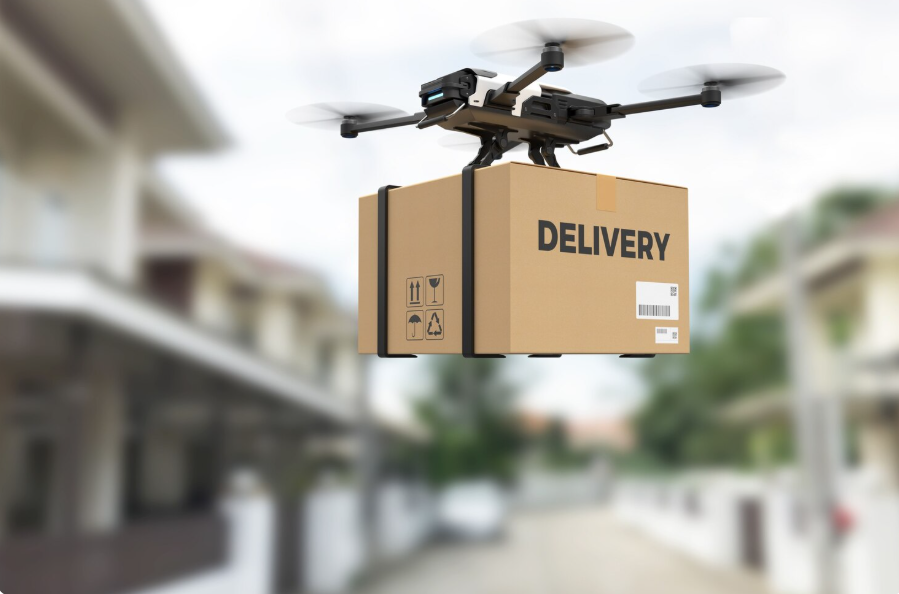
The final stage of a product’s journey from a warehouse or distribution center to the customer’s doorstep is known as last-mile delivery. Although it may sound simple, this stage is often one of the most expensive and complicated parts of the logistics process. Traffic congestion, labor costs, delivery delays, and growing customer expectations can make last-mile operations difficult to manage.
Drone delivery is emerging as a possible solution to many of these challenges. By transporting lightweight packages through the air, delivery drones could help companies move products more quickly while reducing dependence on traditional delivery vehicles.
What Is Drone Delivery?
Drone delivery involves using unmanned aerial vehicles, or UAVs, to transport packages from warehouses, stores, or distribution centers directly to customers or designated collection points.
These drones may be equipped with GPS navigation, sensors, cameras, and automated flight systems. Depending on the delivery model, a drone can land at a designated location, lower a package using a cable, or place it inside a secure delivery area.
The concept is especially attractive for lightweight and time-sensitive products such as medicine, food, electronics, documents, and small retail purchases.
Faster Last-Mile Deliveries
One of the biggest advantages of drone delivery is speed.
Traditional delivery vehicles must travel through streets, stop at intersections, deal with traffic congestion, and follow established road networks. Drones can travel more directly between locations.
For example, a package that might require a delivery van to travel several kilometers through crowded streets could potentially be transported by drone using a much shorter aerial route.
This could make same-day or even rapid delivery more practical for selected products.
Lower Transportation Costs
Last-mile delivery can represent a significant portion of total shipping expenses because companies need drivers, vehicles, fuel, maintenance, and complex delivery routes.
Automated drones could reduce some of these costs.
A single delivery vehicle may still be necessary for large or heavy packages, while drones could handle smaller items. Logistics companies could therefore use a combination of vans, trucks, robots, and drones depending on the type of delivery.
Over time, this hybrid approach could help companies improve efficiency while using traditional vehicles where they are most valuable.
Improving Rural Delivery
Drone technology may be particularly useful in remote or rural communities where traditional transportation infrastructure is limited.
Delivering a small package by truck to a distant location can sometimes be inefficient. A drone may be able to travel directly to the destination without depending on extensive road networks.
Healthcare services could benefit as well. Drones can potentially transport medical supplies, laboratory samples, vaccines, or essential medicines to areas where conventional delivery takes longer.
In these situations, drone logistics may provide benefits that extend beyond ordinary online shopping.
Supporting Faster E-Commerce
Modern consumers increasingly expect flexible and convenient delivery options.
E-commerce companies are therefore constantly looking for ways to improve fulfillment speed. Drone networks could allow certain products to move from nearby fulfillment centers to customers much faster than conventional delivery methods.
Retailers may eventually operate smaller local distribution centers designed specifically for drone deliveries. Products that are frequently ordered could be stored close to major residential areas.
When an order is placed, an automated system could prepare the package, assign a drone, calculate the flight route, and begin delivery.
Environmental Benefits
Electric drones may also contribute to more environmentally efficient delivery systems.
Traditional delivery vans consume fuel or electricity while carrying many packages through long routes. Small electric drones transporting lightweight items could potentially reduce energy consumption for certain deliveries.
However, the environmental impact depends on factors such as battery production, electricity sources, flight distance, payload size, and the logistics network supporting the drones.
Therefore, drones are unlikely to replace every vehicle. Instead, they may become one part of a broader transportation system designed to improve efficiency.
Challenges Facing Drone Delivery
Despite its potential, drone delivery still faces several important challenges.
Airspace regulations are one of the biggest considerations. Governments and aviation authorities must establish rules covering where drones can fly, how high they can operate, and how they should interact with aircraft and populated areas.
Weather is another challenge. Strong winds, heavy rain, extreme temperatures, or poor visibility can affect drone performance.
Battery capacity also limits flight range and payload weight. Smaller drones usually cannot transport large or heavy packages.
Privacy and noise concerns may also become increasingly important if large numbers of drones begin operating over residential neighborhoods.
Safety and Navigation Technology
Reliable navigation systems are essential for large-scale drone delivery.
Delivery drones may use GPS, cameras, radar, sensors, artificial intelligence, and obstacle-detection systems to navigate safely.
Advanced systems could identify buildings, trees, power lines, vehicles, people, and other drones during flight.
Future drone networks may also communicate with centralized traffic-management platforms. These platforms could help coordinate thousands of automated flights and reduce the risk of collisions.
Secure communication systems will also be necessary to prevent unauthorized control or interference.
New Logistics Infrastructure
Widespread drone delivery could create an entirely new type of logistics infrastructure.
Warehouses may include automated drone launch and charging stations. Apartment buildings could include rooftop delivery zones or secure drone lockers.
Retail stores might operate small drone hubs where nearby orders are prepared and dispatched automatically.
Battery-swapping stations could allow drones to quickly replace depleted batteries rather than waiting for them to recharge.
These developments could make drone logistics increasingly integrated with smart cities and automated transportation networks.
Drones Will Likely Complement Traditional Delivery
Drone delivery does not necessarily mean traditional delivery vehicles will disappear.
Large furniture, appliances, construction materials, bulk groceries, and heavy packages will continue to require trucks and vans.
Instead, logistics companies may divide deliveries according to the most efficient transportation method.
Small and urgent packages could travel by drone, heavier products could move by truck, and autonomous ground robots could handle short-distance neighborhood deliveries.
This combination could create a more flexible last-mile logistics system.
The Future of Drone Delivery
The future of drone delivery will depend on improvements in battery technology, automation, regulation, artificial intelligence, and public acceptance.
As drones become more reliable and regulations continue to develop, commercial delivery networks could gradually expand.
The most successful systems are likely to focus on situations where drones provide a clear advantage, such as urgent deliveries, lightweight products, remote locations, or highly congested urban areas.
Rather than completely replacing existing logistics networks, drones are likely to become another important tool within them.
Conclusion
Drone delivery represents an important development in the evolution of last-mile logistics. Faster transportation, automated operations, improved access to remote areas, and potentially lower delivery costs make the technology attractive to retailers and logistics companies.
However, challenges involving regulation, weather, safety, infrastructure, battery performance, and privacy must still be addressed.
As technology continues to improve, drones could become a familiar part of everyday delivery systems. The future of last-mile logistics may involve a combination of trucks, autonomous vehicles, robots, and drones working together to move products more quickly and efficiently.
Read More : Interactive Museums: How Touchscreens and VR Are Changing Exhibits
Conversation