
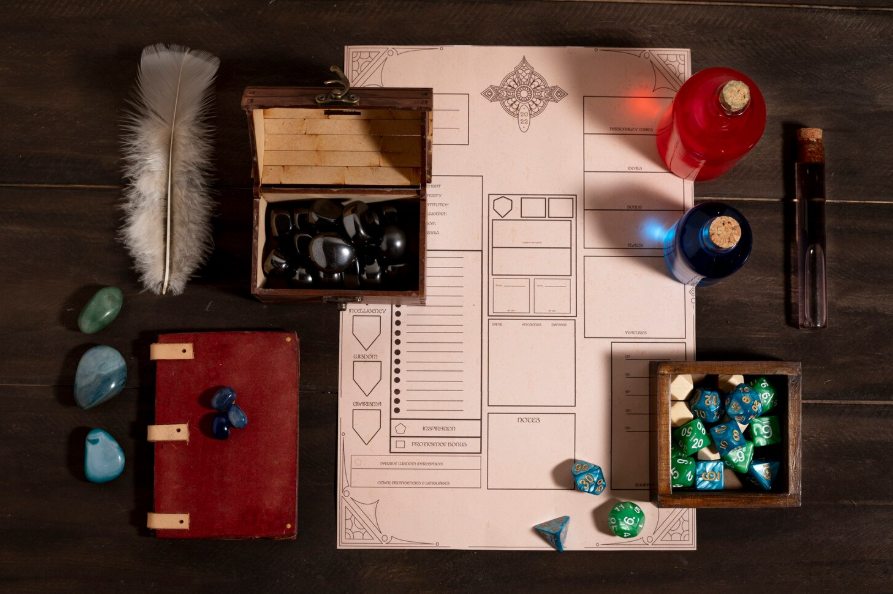
Tabletop role-playing games have become one of the most imaginative forms of social entertainment. Instead of watching a story unfold on a screen, players become part of the story themselves. They make decisions, explore fictional worlds, solve problems, fight monsters, and create memorable moments together.
Among tabletop RPGs, Dungeons & Dragons, commonly called D&D, is the most widely recognized. For a beginner, however, character sheets, strange dice, fantasy classes, and large rulebooks can make the game look more complicated than it really is.
The good news is that you do not need to understand every rule before playing. Most people learn D&D naturally while participating in their first few sessions.
What Is Dungeons & Dragons?
Dungeons & Dragons is a collaborative storytelling game in which players control fictional characters and explore adventures created or guided by another participant known as the Dungeon Master.
Unlike traditional board games, D&D does not usually have one fixed path or a single winner. Players can attempt almost anything that makes sense within the fictional world.
For example, a group might enter an abandoned castle looking for treasure. Instead of fighting the guards at the entrance, players could try to sneak around them, persuade them to leave, create a distraction, or search for another entrance.
The Dungeon Master explains what happens based on the players’ decisions, the game rules, and sometimes the results of dice rolls.
Understanding the Dungeon Master’s Role
The Dungeon Master, often shortened to DM, acts as the narrator and referee of the game.
The DM describes locations, controls non-player characters, introduces challenges, manages enemies, and interprets the rules when necessary.
Suppose a player says, “I want to climb the castle wall.”
The Dungeon Master might ask that player to make an ability check by rolling a die. A successful result could mean the character reaches the top safely. A poor result might cause the character to slip or attract the attention of nearby guards.
The DM does not normally compete against the players. Their goal is to create an interesting world where choices have consequences and everyone can participate in the story.
Creating Your First Character
Creating a character is one of the most exciting parts of starting Dungeons & Dragons.
A character usually has several important elements, including a race or species, class, abilities, equipment, personality, and background.
Classes determine what a character is particularly good at. A fighter specializes in weapons and physical combat, while a wizard relies heavily on magic. Rogues often excel at stealth and clever tactics, while clerics may combine combat abilities with healing and divine magic.
Beginners do not need to choose the most powerful option. Choosing a character concept that sounds enjoyable is usually much more important.
Someone who likes straightforward combat might enjoy playing a fighter. A player who enjoys magic could experiment with a wizard or sorcerer. Someone interested in supporting teammates may prefer a cleric or bard.
Learning About the Dice
Dungeons & Dragons uses several different types of dice.
Players may encounter four-sided, six-sided, eight-sided, ten-sided, twelve-sided, and twenty-sided dice. They are commonly written as d4, d6, d8, d10, d12, and d20.
The twenty-sided die, or d20, is especially important.
When your character attempts something uncertain, such as jumping across a gap, convincing a suspicious merchant, or attacking an enemy, you will often roll a d20 and add a relevant modifier.
The Dungeon Master compares the result against a difficulty level or another character’s defenses.
Higher rolls generally improve your chances of success.
Fortunately, beginners rarely need to memorize which dice are used for every situation. Your character sheet and fellow players can guide you.
Roleplaying Does Not Require Acting Skills
Some beginners worry that they must speak in dramatic voices or behave like professional actors while playing D&D.
That is not necessary.
Roleplaying simply means making decisions from your character’s perspective.
You could speak directly as your character:
“I don’t trust that merchant. I’m going to ask where he found the necklace.”
Or you could describe your actions:
“My character becomes suspicious and asks the merchant about the necklace.”
Both approaches are perfectly acceptable.
As players become more comfortable, they often naturally develop their characters’ personalities, habits, relationships, and motivations.
Understanding Combat
Combat is one of the more structured parts of Dungeons & Dragons.
When a fight begins, characters normally roll initiative to determine the order in which everyone acts. During a turn, a character may move and perform actions such as attacking, casting a spell, helping another character, or interacting with something in the environment.
Weapons and spells often require dice rolls to determine whether attacks succeed and how much damage they cause.
Combat may seem complicated during the first session because players have many possible actions. However, the basic process quickly becomes familiar after a few rounds.
Beginners should focus primarily on understanding what their own character can do rather than memorizing every combat rule.
What You Need to Start Playing
Getting started with D&D requires surprisingly little equipment.
A typical group needs character sheets, pencils, dice, access to the game’s basic rules, and an adventure to play.
Miniature figures and detailed battle maps can make combat easier to visualize, but they are optional. Some groups use simple tokens, coins, paper markers, or even imagination alone.
Digital tools have also made tabletop RPGs easier to access. Online character sheets, virtual dice rollers, and virtual tabletops allow friends to play even when they live in different cities or countries.
Start With a Short Adventure
Beginners often assume they must immediately commit to a campaign lasting months or years.
That is unnecessary.
A short adventure, commonly known as a one-shot, can be an excellent introduction.
One-shots are designed to be completed within a single session or a small number of sessions. Players can experiment with characters and learn basic mechanics without making a long-term commitment.
After completing a short adventure, the group can decide whether they want to continue with the same characters or begin a larger campaign.
Do Not Worry About Memorizing Every Rule
Dungeons & Dragons contains many rules covering combat, magic, movement, equipment, conditions, monsters, and other situations.
Trying to memorize everything before playing is usually unnecessary.
Even experienced players regularly check rules during games.
Beginners should learn a few fundamentals: how ability checks work, where important information appears on their character sheet, how basic combat functions, and what their most common abilities do.
Everything else can be learned gradually.
Communicate With Your Group
Good communication is one of the most important parts of tabletop role-playing.
Different players may enjoy different aspects of D&D. Some people love tactical combat, while others prefer exploration, mysteries, character development, or humorous interactions.
Before beginning a campaign, groups often discuss expectations, preferred themes, scheduling, and topics that players would rather avoid.
These conversations help create an environment where everyone feels comfortable participating.
Mistakes Are Part of the Experience
Beginners will occasionally misunderstand rules, forget abilities, or make decisions that do not work as planned.
That is completely normal.
Unexpected mistakes often create some of the funniest and most memorable moments in tabletop gaming.
D&D is not about playing perfectly. It is about experimenting, working with other players, and seeing where the story goes.
Experienced groups frequently discover that failed plans can produce more entertaining stories than perfectly successful ones.
The Real Appeal of Dungeons & Dragons
The greatest strength of Dungeons & Dragons is freedom.
Video games are limited by the possibilities programmed by developers. Tabletop RPGs are limited mainly by imagination and the rules agreed upon by the group.
A simple mission to retrieve treasure might unexpectedly become a diplomatic negotiation, detective story, rescue mission, or chaotic escape.
Because every player contributes ideas, no two campaigns unfold exactly the same way.
Characters also change over time. They gain abilities, discover new places, develop friendships, make enemies, and sometimes become legendary heroes within a world created collectively by the group.
Final Thoughts
Starting Dungeons & Dragons may seem intimidating when you first encounter character sheets, dice sets, spell descriptions, and rulebooks. In practice, the easiest way to learn is simply to begin playing.
Create a character that sounds interesting, learn the most important abilities on your sheet, and allow the Dungeon Master and other players to guide you through unfamiliar rules.
Tabletop RPGs are ultimately about imagination, collaboration, and shared storytelling rather than perfect knowledge of game mechanics.
Once the dice begin rolling and your group starts making decisions together, the rules quickly become secondary to the adventures, surprises, and stories you create along the way.
Read More: Interactive Museums: How Touchscreens and VR Are Changing Exhibits